Morse code looks intimidating the first time you see it. A wall of dots and dashes. No vowels, no spaces you can recognize, nothing that looks like English.
But here’s the thing: Morse code is actually one of the simplest “languages” you’ll ever learn. It only has two symbols. That’s it. A dot and a dash. Once you understand how those two symbols combine, you can read and write Morse code faster than you’d think.
This guide walks you through everything — from what Morse code actually is, to reading it, writing it, and practicing it daily until it sticks.
What Is Morse Code?
Morse code is a way of representing letters, numbers, and punctuation using two signals: a short one (called a “dot” or “dit”) and a long one (called a “dash” or “dah”).
That’s the whole system. Every letter of the alphabet, every number, and most punctuation marks are built from combinations of just these two signals.
A few important things to understand right away:
- Morse code is not a language. It doesn’t have its own grammar or vocabulary. It’s a code — a way of encoding the alphabet you already know.
- It can be sent in different ways: as sound (beeps), as light (flashes from a flashlight or lighthouse), or as physical taps (on a table, a wall, anything).
- The letter “E” is a single dot. The letter “A” is a dot followed by a dash. Longer, less common letters get longer patterns.
Here’s a simple example to get you oriented. The word “SOS” — probably the most recognizable Morse code sequence in the world — looks like this:
S = ...
O = ---
S = ...
So “SOS” is: ... --- ...
Three short signals, three long signals, three short signals. Simple, memorable, and unmistakable — which is exactly why it became the international distress signal.
Who Invented Morse Code and Why?
Morse code was developed in the 1830s and 1840s by Samuel Morse, along with Alfred Vail, for use with the electric telegraph. Before Morse code, sending a message over long distances meant physically carrying it — by horse, by ship, or by foot.
The telegraph changed that. But a telegraph wire can only do one thing: turn an electrical signal on and off. Morse and Vail needed a way to represent an entire alphabet using nothing but “on” and “off.” Their solution — short pulses and long pulses — is the same basic idea we still use today.
The version taught worldwide now is called International Morse Code. It replaced an earlier version (sometimes called American Morse Code) that had more complex timing and extra symbols. International Morse Code is simpler and more standardized, which is part of why it’s still around.
Why Morse Code Still Matters Today
You might be wondering why anyone bothers learning Morse code in an age of smartphones and instant messaging. Turns out, it still has real, practical uses:
- Emergency signaling. SOS is still recognized worldwide as a distress call, and it doesn’t need batteries, a signal tower, or an app — just a light, a whistle, or a flashlight.
- Amateur (ham) radio. Morse code, often called “CW” in radio circles, is still used by radio operators because it can transmit over long distances with very low power, even when voice signals can’t get through.
- Assistive technology. Some communication devices for people with physical disabilities use Morse code input (like blinking or tapping) as an alternative to typing or speaking.
- Puzzles, games, and learning. Escape rooms, puzzle hunts, and even some video games use Morse code as a fun challenge for players.
It’s not something you’ll use every day. But knowing it is one of those skills that’s genuinely useful in a surprising number of situations — and it’s a lot easier to learn than most people assume.
The Building Blocks: Dots, Dashes, and Timing
Before you memorize a single letter, you need to understand timing. This is the part beginners skip — and it’s the part that actually makes Morse code work.
Morse code timing is based on a simple unit system:
- A dot (dit) = 1 unit of time
- A dash (dah) = 3 units of time
- The space between dots and dashes within the same letter = 1 unit
- The space between two letters = 3 units
- The space between two words = 7 units
Think of it like musical rhythm. If a dot is one beat, a dash is three beats held in a row. The pauses matter just as much as the sounds themselves — a pause in the wrong place can turn one letter into a completely different one.
Why Timing Matters More Than Speed
New learners almost always make the same mistake: they focus on getting fast before they get consistent. That backfires.
If your timing is inconsistent, your dashes start sounding like dots, and your letter breaks disappear. The result is a jumble that’s impossible to read — even if you technically “know” the alphabet.
Slow down and keep a steady rhythm first. Speed comes naturally once the rhythm is automatic. This is genuinely how radio operators are trained, and it works just as well for beginners learning on their own.
The Complete Morse Code Alphabet
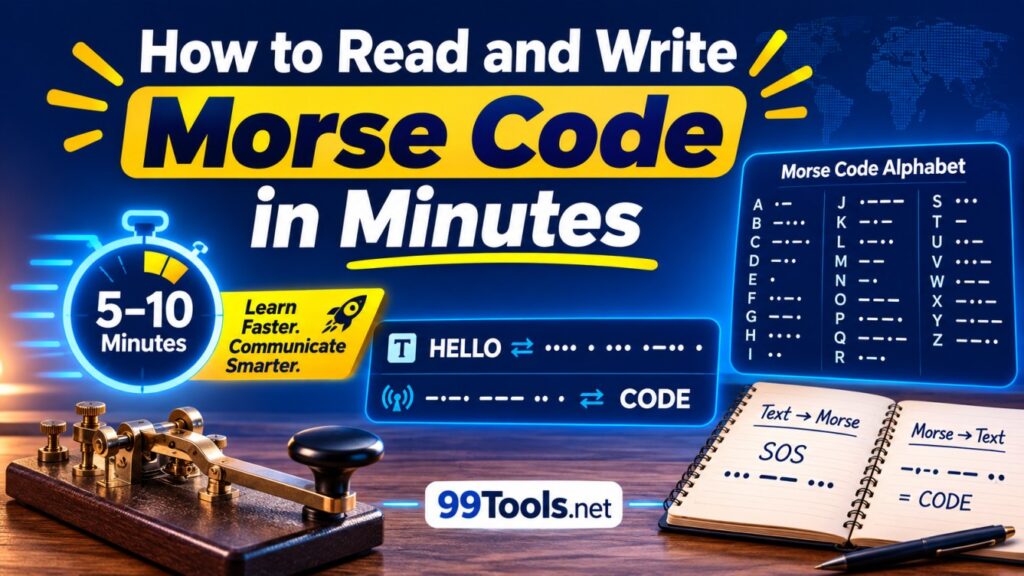
Here’s the full chart. Don’t try to memorize all 26 letters today — just use this as your reference while you practice reading and writing.
| Letter | Code | Letter | Code |
|---|---|---|---|
| A | .- | N | -. |
| B | -… | O | — |
| C | -.-. | P | .–. |
| D | -.. | Q | –.- |
| E | . | R | .-. |
| F | ..-. | S | … |
| G | –. | T | – |
| H | …. | U | ..- |
| I | .. | V | …- |
| J | .— | W | .– |
| K | -.- | X | -..- |
| L | .-.. | Y | -.– |
| M | — | Z | –.. |
Notice something: the most common letters in English — E, T, A, I, N, O, S — have the shortest patterns. That’s not a coincidence. Morse designed the code so that frequently used letters take the least time to send. E is just one dot. T is just one dash. That single design choice is also what makes learning easier — you get the most useful letters first, and they’re the simplest ones.
A few pairs tend to trip beginners up because they look and sound similar:
- B (-…) vs. D (-..) — B has one extra dot at the end
- U (..-) vs. V (…-) — V has one extra dot before the dash
- G (–.) vs. W (.–) — same three symbols, different order
If you keep confusing two letters, put them side by side and practice just those two until the difference feels obvious.
Morse Code Numbers
Numbers in Morse code follow a much more predictable pattern than letters, which makes them genuinely easy to pick up quickly.
| Number | Code |
|---|---|
| 1 | .—- |
| 2 | ..— |
| 3 | …– |
| 4 | ….- |
| 5 | ….. |
| 6 | -…. |
| 7 | –… |
| 8 | —.. |
| 9 | —-. |
| 0 | —– |
Look at the pattern: 1 through 5 count up in dots, then switch to dashes counting down from 5 to 0. Once you see that logic, you don’t really need to memorize ten separate codes — you just need to remember the pattern.
Common Morse Code Punctuation
You won’t need punctuation nearly as often as letters and numbers, but it’s good to know the basics:
- Period (.) —
.-.-.- - Comma (,) —
--..-- - Question mark (?) —
..--.. - Hyphen (-) —
-....- - Slash (/) —
-..-.
There are also a few special sequences called prosigns — procedural signals used to manage a conversation rather than spell out words. The most well-known is SOS (... --- ...), and another common one is AR (.-.-.), which signals the end of a message.
Don’t worry about memorizing punctuation early on. Get comfortable with letters and numbers first — punctuation is easy to pick up later once the basics are automatic.
How to Read Morse Code (Step by Step)
Reading Morse code isn’t about counting individual dots and dashes one at a time — that’s slow and error-prone. Instead, you want to train yourself to recognize each letter as a whole shape or rhythm, the same way you recognize a friend’s face instantly instead of analyzing their features one by one.
Here’s the process:
- Listen or watch for groupings, not single signals. A cluster of dots and dashes with a small pause after it is one letter.
- Use the pause length to find letter and word boundaries. A short pause separates letters; a longer pause separates words.
- Match each group to a letter using the chart. At first, you’ll look this up. Over time, you’ll just know it.
- Start with short, familiar words. Don’t jump into full sentences on day one.
Example: Try decoding this sequence:
.... . .-.. .-.. ---
Break it into groups:
....= H.= E.-..= L.-..= L---= O
Put it together: HELLO
That’s the entire process. It feels slow at first, and that’s completely normal — every skill feels slow before it feels automatic.
Common Mistakes When Reading Morse Code
- Counting symbols instead of recognizing patterns. Counting works for a while, but it’s slow. Aim to recognize shapes, not tally marks.
- Losing track of where one letter ends and the next begins. This is almost always a timing issue — go back and review the timing rules above.
- Trying to read at full speed too soon. Slow, accurate reading beats fast, sloppy reading every time.
- Ignoring rhythm entirely. If you only look at the chart and never listen to actual Morse code, you’ll struggle when you hear it in real life.
How to Write Morse Code (Step by Step)
Writing Morse code is really just the reverse process: instead of translating symbols into letters, you’re translating letters into symbols.
- Break your message into individual letters.
- Convert each letter using the Morse chart.
- Add the correct spacing — one unit between symbols in a letter, three units between letters, seven units between words.
- Double-check your work against a chart or a translator before you rely on it.
Example: Let’s encode the word “HELP.”
- H =
.... - E =
. - L =
.-.. - P =
.--.
Full message: .... . .-.. .--.
How to Write Morse Code by Hand
If you’re writing Morse code on paper, a few small habits make a big difference:
- Make your dashes clearly longer than your dots — about three times the width — so there’s no ambiguity later when you (or someone else) reads it back.
- Leave visible gaps between letters. A cramped line of dots and dashes is genuinely hard to decode, even for someone experienced.
- Group letters into words with a clear space, the same way you’d space out written English.
[Diagram suggestion: a simple handwritten example showing correctly spaced dots and dashes next to a cramped, poorly spaced example, so readers can visually compare the two.]
How to Pronounce Morse Code Out Loud
Saying Morse code out loud is one of the most underrated ways to learn it. Verbal practice trains your brain to recognize the rhythm of each letter, not just its written shape — and rhythm is what you’ll actually be reading when you hear real Morse code.
The standard pronunciation is:
- Dot = “dit”
- Dash = “dah”
So S (...) is spoken as “dit-dit-dit,” and O (---) is spoken as “dah-dah-dah.”
Put it together, and SOS becomes: “dit-dit-dit, dah-dah-dah, dit-dit-dit.”
Try saying your own name out loud in Morse code using dits and dahs. It feels a little silly at first, but it works — verbal repetition is one of the fastest ways to make patterns stick in memory.
Practice Faster With a Morse Code Translator
Once you’ve learned the basics, the fastest way to build confidence is to check your work. Manually translating letter by letter is great for learning, but it’s easy to make small mistakes, especially early on.
This is where a tool like the Morse Code Translator on 99tools.net is genuinely useful. You can type in a word or sentence and instantly see the Morse code version, or paste in a string of dots and dashes to see it decoded back into text.
It’s a good way to:
- Verify a translation you did by hand
- Quickly generate practice material without flipping through a chart
- Decode something you’re stuck on so you can learn from the correct answer
Think of it less as a shortcut and more as an answer key — something you check after trying it yourself, not instead of trying.
Easy Memorization Techniques for Morse Code
Straight memorization — just staring at a chart — is the slowest way to learn Morse code. These methods work better:
- Rhythm association. Say each letter’s pattern out loud with a consistent beat, almost like a drumline. Your ear picks up rhythm faster than your eyes pick up symbols.
- Chunking. Learn 3–4 letters at a time instead of trying to absorb all 26 at once. Master that small group before moving on.
- Group by pattern similarity. Learn all-dot letters together (E, I, S, H), then all-dash letters together (T, M, O), then mixed patterns. Grouping by structure makes the differences easier to spot.
- Mnemonic phrases. Some learners create short phrases where the syllable count or stress matches the dot-dash pattern of a letter. Whatever memory trick works for you personally, use it — there’s no single “correct” method.
[Diagram suggestion: a cheat sheet grouping letters by pattern type — all-dot letters, all-dash letters, and mixed — so learners can see the logical clusters at a glance.]
The Farnsworth Method
If you want to learn faster, look into the Farnsworth method — a training approach commonly used by ham radio instructors.
The idea is simple: you send each individual letter at full, normal speed, but you leave longer pauses between letters. This trains your ear to recognize the shape of each letter quickly, without the pressure of keeping up with a fast overall pace.
It’s one of the most effective methods for beginners because it builds accurate recognition first, and speed naturally follows later.
Beginner Learning Roadmap
Here’s a realistic week-by-week plan if you want structure instead of just diving in randomly:
- Days 1–2: Learn the simplest, most common letters first — E, T, A, N, I, M, S, O. These cover a huge percentage of everyday English.
- Days 3–4: Add the remaining consonants in small groups of 3–4 letters at a time.
- Day 5: Learn the numbers 0–9. Remember, they follow a predictable pattern, so this should be quick.
- Day 6: Practice full words — start combining letters into real vocabulary.
- Day 7: Practice full sentences, and use a translator to check your accuracy.
Ten to fifteen minutes a day is genuinely enough. Consistency beats cramming every time — your brain needs repeated, spaced exposure to actually retain the patterns long-term.
Practice Exercises to Build Real Skill
Practice Words for Beginners
Try decoding these on your own before checking the answers:
-.-. .- -→ CAT-.. --- --.→ DOG... --- ...→ SOS.... . .-.. .--.→ HELP... ..- -.→ SUN-... --- --- -.-→ BOOK-.-. .- .-.. .-..→ CALL-. --- .--→ NOW
Cover the answers with your hand, decode each one, and only check yourself afterward.
Practice Sentences for Intermediate Learners
Once single words feel easy, move up to short sentences:
-.-. .- .-.. .-.. / -- . / -. --- .--→ “CALL ME NOW”... . -. -.. / .... . .-.. .--.→ “SEND HELP”.. / .- -- / --- -.- .- -.--→ “I AM OKAY”
(The / symbol here just marks a word break for readability.)
Daily Practice Habits That Actually Work
- Practice little and often. Ten minutes daily beats two hours once a week.
- Practice both directions. Reading Morse code and writing it are two different skills — don’t neglect either one.
- Say it out loud. Verbal practice reinforces rhythm recognition far better than silent reading.
- Practice with another person. Tap out a message to a friend and have them decode it — real back-and-forth practice mimics how Morse code is actually used.
Real-World Applications of Morse Code Today
Morse Code in Emergency Situations
SOS (... --- ...) became the international distress signal because it’s short, simple, and impossible to mistake for anything else. It doesn’t spell “Save Our Ship” or “Save Our Souls” — those are just memory aids people came up with later. It was chosen purely because the pattern is easy to send and easy to recognize, even under stress.
Knowing SOS means you can signal for help with a flashlight, a whistle, or by tapping on a wall — no equipment required beyond something that can make three short signals and three long ones.
Morse Code in Aviation
Pilots still encounter Morse code today, even without realizing it. Radio navigation beacons — VOR and NDB systems — broadcast a short Morse code identifier so pilots can confirm they’re tuned to the correct station. It’s a small but real example of Morse code still working quietly in the background of modern aviation.
Morse Code in Military and Maritime Use
Morse code played a massive role in military and naval communication throughout the 20th century, especially before reliable voice radio existed. Its use has declined significantly with modern digital communication, but it’s still taught in some military and maritime training programs as a backup skill.
Morse Code in Ham Radio
Among amateur radio operators, Morse code is often called “CW” (continuous wave), and it’s still actively used today — not out of nostalgia, but because it works. CW signals can travel further on lower power than voice transmissions, and they can often get through when voice signals can’t.
Morse Code in Modern Technology
Morse code shows up in some surprisingly modern places:
- Assistive communication devices for people with physical disabilities, where a single switch (like a button or a blink sensor) can be used to input Morse code instead of typing.
- Developer and hobbyist projects, like Arduino-based Morse code transmitters, LED signaling projects, or simple encoding/decoding apps.
If you’re a developer exploring Morse code as a coding project, understanding the timing rules covered earlier in this guide is essential — most bugs in DIY Morse code projects come from getting the unit timing wrong, not the letter patterns themselves.
Morse Code Myths vs. Facts
Myth: Morse code is a language. Fact: It’s an encoding system for existing languages, not a language with its own grammar or vocabulary.
Myth: Morse code is obsolete and no longer used. Fact: It’s still actively used in aviation navigation, amateur radio, and emergency signaling.
Myth: You need a musical ear or special talent to learn it. Fact: Anyone can learn Morse code with consistent practice — it’s a learnable skill, not an innate talent.
Myth: Learning Morse code takes years. Fact: The core alphabet can be learned in about a week with focused, short daily practice. Real fluency takes longer, but basic competency comes fast.
Myth: Morse code is the same everywhere and always has been. Fact: The current standard is International Morse Code. An older version, American Morse Code, used different timing and symbols and is largely obsolete now.
Common Beginner Mistakes to Avoid
A quick recap, since these mistakes come up again and again:
- Trying to memorize all 26 letters in one sitting instead of learning in small chunks
- Focusing only on the symbols and ignoring timing and rhythm
- Practicing reading but never practicing writing (or vice versa)
- Skipping verbal practice — saying “dit” and “dah” out loud speeds up recognition significantly
- Relying entirely on a chart without ever testing yourself through active recall
Frequently Asked Questions
How long does it take to learn Morse code?
Most people can learn the full alphabet and basic numbers within one to two weeks of short daily practice sessions. Building real speed and fluency takes longer — often several months of regular use.
What is the fastest way to learn Morse code?
Learn letters in small chunks, practice out loud using “dit” and “dah,” and use the Farnsworth method — full-speed letters with longer pauses between them — to build accurate recognition before focusing on speed.
Is Morse code still used today?
Yes. It’s used in amateur radio, aviation navigation beacons, emergency signaling (like SOS), and some assistive communication technology.
What does SOS mean in Morse code, and why was it chosen?
SOS doesn’t stand for anything — it was chosen because its pattern (three dots, three dashes, three dots) is simple, fast to send, and impossible to confuse with anything else.
Can I learn Morse code without a teacher?
Yes. Morse code is commonly self-taught using charts, audio practice, and translator tools to check your work as you go.
What’s the difference between Morse code and semaphore?
Morse code uses two signals (short and long) sent as sound, light, or taps. Semaphore uses flag positions held by a person to represent letters. They’re both signaling systems, but they work completely differently.
Do I need to know Morse code for a ham radio license?
In most countries today, Morse code proficiency is no longer required for amateur radio licensing, though it remains a popular and useful skill among operators, especially for long-distance, low-power communication.
What is the easiest letter to start learning in Morse code?
E, which is a single dot, and T, which is a single dash, are the easiest and most common starting points.
How do you say “I love you” in Morse code?
Each letter is translated individually: I = .., L = .-.., O = ---, V = ...-, E = ., Y = -.--, O = ---, U = ..-. Written out: .. .-.. --- ...- . -.-- --- ..-
Can Morse code be used with light signals?
Yes. Flashing a light in short and long bursts — like with a flashlight — is one of the most common non-audio ways to send Morse code, especially in emergency situations.
What’s the difference between American Morse and International Morse Code?
American Morse Code was an earlier version with more complex timing and extra symbols. International Morse Code, developed later, simplified the system and is the standard used worldwide today.
How do you type Morse code on a keyboard?
There’s no dedicated Morse keyboard layout in standard use — instead, people typically type the corresponding letters in text and use a translator tool to convert them into Morse code symbols.
Is Morse code a good brain exercise?
Many learners find it a genuinely engaging mental workout, since it combines pattern recognition, rhythm, and memory in a way that’s different from typical language learning.
What is the best way to check if my Morse code translation is correct?
Cross-checking with a reliable Morse Code Translator, like the one on 99tools.net, is a quick way to confirm your manual translation before you rely on it.
Can Morse code be tapped instead of spoken or written?
Yes. Tapping is one of the most versatile ways to send Morse code — short taps for dots, longer taps (or double-taps) for dashes — and it’s commonly used in situations where sound or light isn’t practical.