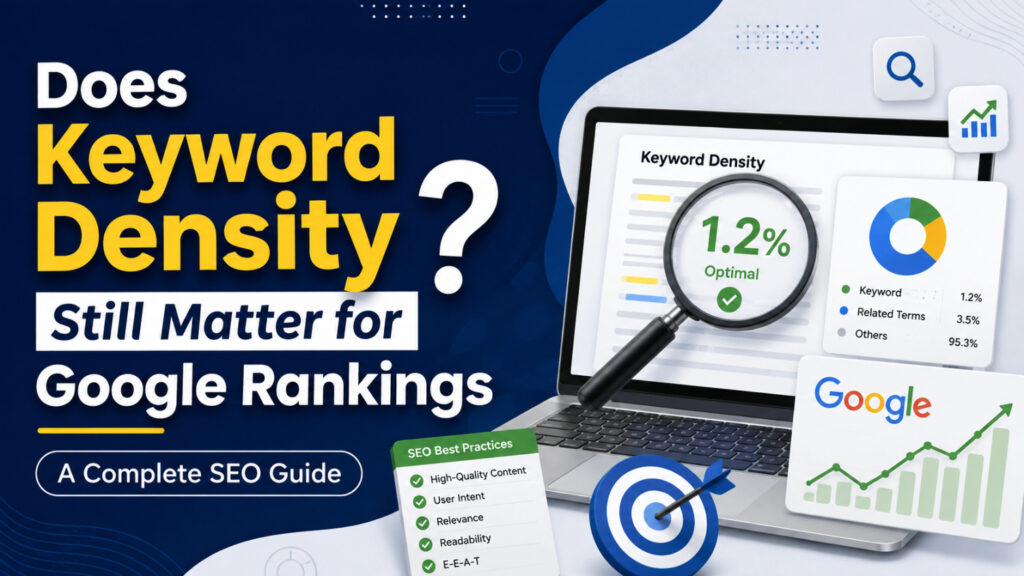
If you’ve spent any time in SEO forums, you’ve seen this question asked a hundred different ways. “What’s the ideal keyword density?” “Should I aim for 2%?” “My competitor uses the keyword 15 times — should I use 16?”
I get why the question won’t die. It feels measurable. It feels like something you can control. Word count, keyword count, divide, done. Compare that to something fuzzy like “write helpful content,” and it’s easy to see why density calculators became a staple of every SEO toolkit.
But here’s the short version, and I’ll spend the rest of this post backing it up: keyword density is not a Google ranking factor. Google has said this directly, more than once, for over a decade. What still matters is something related but different — using the right words, in the right places, in a way that reads naturally to an actual human.
Let’s get into the details.
What Is Keyword Density, Exactly?
Keyword density is simply how often a word or phrase shows up in your content, expressed as a percentage of your total word count.
The formula looks like this:
(Number of times the keyword appears ÷ Total word count) × 100 = Keyword density
So if you write a 1,000-word article and use the phrase “home coffee roasting” 10 times, your keyword density for that phrase is 1%.
That’s it. It’s a simple ratio. The confusion doesn’t come from the math — it comes from the idea that there’s a “correct” percentage to hit. You’ll see old SEO guides claim you need 1–3%, or that 2.5% is the magic number. There’s no source for these numbers. They’re not from Google. They’re not backed by any published study that holds up. They’re just numbers that got repeated so often they started to sound official.
What Google Has Actually Said About It
You don’t have to guess where Google stands on this. They’ve addressed it directly, repeatedly, over many years.
When a user on Reddit asked Google’s Search Advocate John Mueller in late 2021 whether keyword density was still an SEO factor, he answered with a single word: “no.” No caveat, no “it depends.” Just no.
That wasn’t a one-off comment. Mueller has made similar statements going back years, describing keyword density as something he “wouldn’t worry about.” Google has never published an ideal density number, because as far as their systems are concerned, the concept doesn’t map to how modern ranking actually works.
If you want the primary source rather than secondhand commentary, Google’s own developer documentation backs this up in spirit, even if it doesn’t use the phrase “keyword density” directly:
- Google Search Essentials lays out what actually determines whether your content is eligible to rank — and it centers on helpful content and technical accessibility, not word ratios.
- Creating Helpful, Reliable, People-First Content explains E-E-A-T (experience, expertise, authoritativeness, trust) — the framework Google’s systems actually use to evaluate content quality.
Nowhere in either document will you find a target percentage for keyword usage. That’s not an oversight. It’s because Google’s systems moved past counting keywords a long time ago.
You may also come across claims that a 2024 leak of internal Google API documentation proves “term frequency” is a hidden ranking factor after all. It’s worth being cautious here — Google has never confirmed that those documents reflect how live ranking actually works, and “term frequency” in an internal system isn’t the same thing as “hit a target density in your blog post.” I’d treat that argument as unproven rather than settled.
Why Keyword Density Used to Matter
It’s worth understanding why this idea existed in the first place, because it wasn’t always wrong.
In the earliest days of search engines — we’re talking late 1990s — ranking systems were fairly literal. They mostly matched the exact words in your query to the exact words on a page. If you wanted to rank for “cheap flights to Rome,” having that phrase on your page, repeated a reasonable number of times, genuinely helped. Search engines simply weren’t sophisticated enough to understand meaning. They could only count.
Naturally, this got exploited. Pages became stuffed with repeated phrases, sometimes hidden in white text on white backgrounds, purely to game the count. It worked, for a while.
Then search engines got smarter. Google’s Hummingbird update in 2013 was a major shift toward understanding the intent behind a search query rather than just matching words. Later updates like RankBrain and BERT pushed this even further, giving Google’s systems a much deeper grasp of language, context, and meaning. A page no longer needed to say “best running shoes” fifteen times to be understood as a page about the best running shoes.
Keyword density didn’t get switched off overnight. It just became less and less useful as the technology around it advanced — to the point where, today, it has essentially no direct bearing on rankings.
What Actually Influences Rankings Today
If it’s not density, what is Google actually looking at? A few things consistently come up.
Search intent match. Does your page actually answer what someone typing that query wants? A recipe page ranking for “how long to boil an egg” needs a clear, fast answer — not three paragraphs of backstory before the number shows up.
E-E-A-T. Experience, expertise, authoritativeness, and trust. Google’s own content guidance calls trust the most important of these — the others exist to build it. A product review written by someone who’s actually used the product reads differently than one that isn’t, and Google’s systems are increasingly good at telling the difference.
Topical depth. Covering a subject thoroughly — including the related questions people actually have — signals relevance far more effectively than repeating one exact phrase. If you’re writing about “training for a 5K,” covering pacing, injury prevention, and race-day nutrition tells Google (and readers) you actually understand the topic.
Technical basics. Content can be excellent and still not rank if Google can’t crawl or render it properly. This is covered in Google’s SEO Starter Guide, which is worth reading in full if you haven’t.
None of these are about counting words. They’re about whether the page is genuinely useful.
Keyword Stuffing: The Real Risk
Here’s where things flip. While low keyword density doesn’t hurt you, overdoing it can.
Google explicitly names keyword stuffing as a violation in its spam policies for Google Web Search. Their definition: filling a page with keywords or numbers in an attempt to manipulate rankings, often in ways that appear unnatural or out of context.
What this looks like in practice:
- A landing page that repeats “best plumber Chicago” in nearly every sentence, whether it makes grammatical sense or not
- Lists of city names or phone numbers stacked in a footer with no context
- Product pages that read like a thesaurus entry instead of actual product information
If your site gets flagged for this, Google can apply a manual action — a human reviewer’s penalty that can significantly hurt your visibility. Search Console’s guidance on manual actions walks through exactly how to identify and fix this if it happens to you, including checking for hidden text using color tricks or CSS positioning.
The irony is that stuffing rarely even achieves its goal anymore. Modern algorithms are good at spotting text that doesn’t read naturally. You’re taking on real risk for a tactic that doesn’t work the way it used to.
So Should You Ignore Keywords Completely?
No — and this is the part that trips people up. Just because density doesn’t matter doesn’t mean keywords are irrelevant.
Google still needs to understand what your page is about. Using your target keyword (and its natural variations) in the right places still helps with that. It’s just not about hitting a number — it’s about placement and context.
Places where it’s genuinely useful to include your keyword naturally:
- Title tag and H1 — this is often the first thing both readers and Google see
- The first paragraph or two — sets context early
- Subheadings, where it fits — helps structure and scannability
- Image alt text — describes the image accurately, which also happens to help accessibility
- Meta description — not a ranking factor itself, but it affects whether people click
Beyond that exact phrase, using related terms and synonyms matters more than people expect. If your target keyword is “electric bike,” naturally working in terms like “e-bike,” “battery range,” or “pedal assist” tells Google you’re covering the topic broadly — not just repeating a phrase.
Write the sentence the way you’d say it out loud to a person. If it sounds robotic, it’s probably not helping.
How to Check Your Keyword Usage Without Obsessing Over It
Even though density isn’t a ranking factor, it’s still a reasonable thing to glance at before you hit publish — not to hit a target, but to catch the opposite problem: accidental over-repetition that you didn’t notice while writing.
This happens more than people think. You’re focused on getting the point across, and you end up leaning on the same phrase five times in three paragraphs without realizing it. A quick check catches that before a reader does.
One way to do this is with a keyword density checker, which scans your draft and shows you how often each word or phrase appears relative to your total word count.
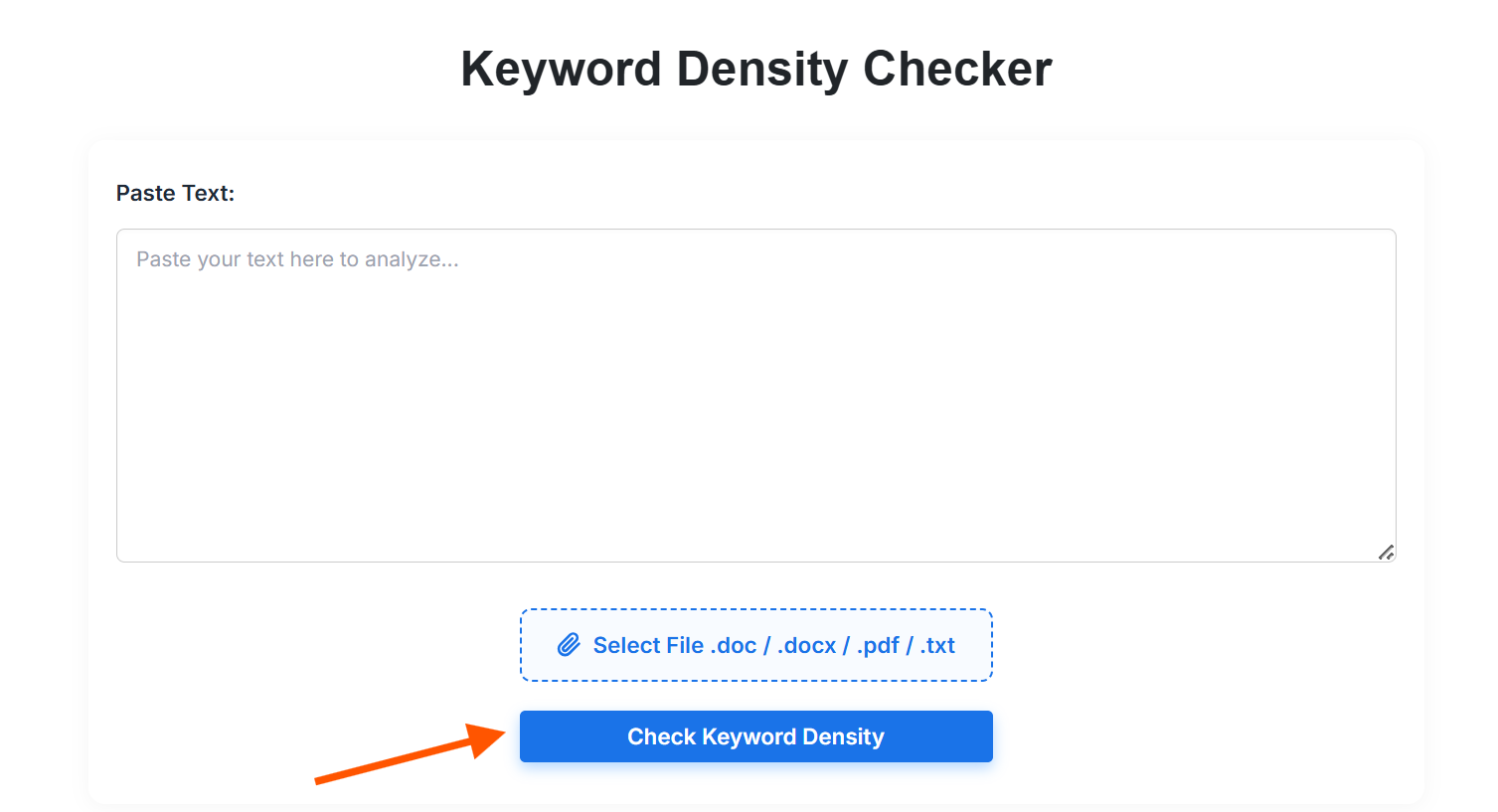
Here’s how it works, in practice:
- Paste your draft into the text box — or upload the file directly if it’s already saved as a .doc, .docx, .pdf, or .txt
- Click “Check Keyword Density”
- Review the breakdown — you’ll see each significant word or phrase and what percentage of your total content it makes up
- Look for outliers, not targets — if one phrase is dramatically more frequent than everything else, that’s your cue to vary the wording, not evidence you’re “under-optimized” if the number is low
Treat the output as a mirror, not a scoreboard. It’s there to reflect back what you actually wrote, so you can catch repetition your eyes glossed over.
If you want to go a level deeper — looking at word usage across your content generally, not just one target keyword — a word frequency analysis is a useful companion check. It’s especially handy for longer pieces where you want to see your overall vocabulary patterns, not just one phrase.
Best Practices for Natural Keyword Use in 2026
A short, practical list to keep in mind as you write:
- Write for the reader first. Get the point across clearly. Check keyword placement after, not during.
- Use synonyms and related terms. Repetition of the exact phrase reads worse than natural variation, and it doesn’t help rankings anyway.
- Answer the related questions. If someone searching your topic would also wonder about something adjacent, address it. This is often what separates a thin page from a genuinely useful one.
- Let your structure do some of the work. Clear headers and logical flow help both readers and Google understand what each section covers.
- Re-check after editing. Density can shift as you revise — a phrase you cut once from an early draft might reappear if you’re not paying attention during rewrites.
Common Keyword Density Myths, Debunked
Myth: There’s an ideal density, like 1–3%. Fact: No such number has ever come from Google. It’s a figure that spread through SEO folklore, not documentation.
Myth: Low density will hurt your rankings. Fact: There’s no evidence for this. A page can use a keyword once, naturally, and still rank well if it thoroughly answers the query.
Myth: More repetition means more relevance. Fact: Relevance comes from actually covering the topic well. Past a certain point, more repetition just makes content harder to read — and reads as spam to modern algorithms.
Myth: Google penalizes any repeated word. Fact: Normal, natural repetition is fine and expected. It’s only unnatural, forced stuffing that triggers spam policies.
FAQ
Is there an optimal keyword density for SEO?
No. Google has never published a target percentage, and multiple statements from their own Search Advocate confirm density isn’t something they use to rank pages.
Does Google use something like TF-IDF instead?
TF-IDF (term frequency-inverse document frequency) is a concept from information retrieval that some SEO tools reference, but Google hasn’t confirmed it’s used as a direct ranking signal in the way density calculators imply. It’s best treated as a content-analysis concept, not a ranking formula to reverse-engineer.
Will keyword stuffing get my site penalized?
It can. Google’s spam policies name keyword stuffing explicitly, and violations can lead to a manual action that significantly reduces visibility until it’s fixed and reviewed.
How many times should I use my keyword in a 1,000-word post?
There’s no fixed number. Use it where it fits naturally — typically the title, an early paragraph, a subheading or two — and let the rest of the content focus on genuinely covering the topic.
Related Reading
If you’re working with content on a site you didn’t build from scratch — say, one built on an expired domain — auditing existing keyword usage is a useful first step. Here’s a full guide to expired domains for SEO in 2026 if that applies to you.
And if you want to look beyond a single target keyword to see how your overall content reads, how to analyze word frequency in any text is a good next read.
The Bottom Line
Keyword density isn’t a ranking factor, and it hasn’t been for a long time. Google has said so directly, and their own documentation reflects a completely different set of priorities — helpfulness, relevance, and trust.
That doesn’t mean keywords don’t matter at all. It means the old way of thinking about them — as a number to hit — was never really the point. The point was always making sure your content clearly and naturally covers what people are searching for.
Write it for the person reading it. Check it once before you publish, mostly to catch repetition you didn’t notice. Then let the content speak for itself.